Emulation itself is legal in the UK. Downloading a ROM of a game you do not own is not. The confusion comes from treating the two as one thing. An emulator is software. A ROM is a copy of a copyrighted game. A BIOS file is often a copy of copyrighted console firmware. UK law treats each one differently under the Copyright, Designs and Patents Act 1988 (CDPA). It is general information, not legal advice.
The short answer
Emulators are legal to create, download and use in the UK, provided the emulator does not contain stolen code. A ROM you made yourself from a game you lawfully own, for private use only, sits in a far stronger position than a ROM downloaded from a website, although even that area is narrower than most guides admit. Downloading or sharing ROMs of games you do not own infringes copyright, even if the game is old or out of print.
What an emulator is
An emulator imitates the hardware of another machine, so a game written for one console can run on a PC, a phone or a different console. Good emulators are written from scratch: developers study how the original hardware behaves and write new code that does the same, without copying the console maker’s code.
That matters because copyright protects the expression of a work, such as code, art and music. It does not protect an idea or a hardware behaviour. An independently written emulator is therefore a new work, not a copy of the console. In the United States, Sony lost cases against the PlayStation emulators Bleem and Connectix Virtual Game Station around 2000. UK law has no general fair use defence, so details differ, but writing compatible software is not copying a game. The limit is clear: an emulator stops being clearly safe if it depends on copied console code.
What a ROM is
A ROM is a digital copy of the data on a game cartridge, disc or arcade board. Downloading one makes a copy of a copyrighted work. Uploading one also communicates it to the public. Under the CDPA, the copyright owner alone may copy their work and communicate it to the public. A game is usually several works at once: code, artwork, music and story text. UK copyright in most such works lasts for the life of the author plus 70 years, so a 1990s game is almost certainly still protected.
The legal split at a glance
| Item | UK position |
|---|---|
| Independently written emulator | Legal to download and use. |
| BIOS or firmware file | Usually copyrighted. Downloading or sharing one you do not lawfully hold is infringement. |
| ROM dumped by you from your own game | Strongest player position, private use only, still narrow. |
| ROM downloaded from the internet | Infringes copyright, even if you own the same game physically. |
| ROM uploaded, shared or sold | Clear infringement. Distribution is treated far more seriously. |
| Device preloaded with ROMs for sale | High risk commercial distribution. |
Does owning the game make downloading a ROM legal?
No. This is the most common mistake in online guides. Copyright is about copying, not about whether you paid for the game once in another format. When you download a ROM from a site, a new copy is made from that site’s copy, without permission. Owning a cartridge does not authorise that site to distribute the game, or you to take its copy. The lawful route, where one exists, is to make your own copy from your own game and keep it for yourself.
Even that route is narrow. UK law lets a lawful user of a computer program make a back-up copy where necessary for lawful use. A game is not only a program: it also contains art, music and other protected material, and the back-up provision does not override those rights. Bypassing copy protection can also be unlawful even when you own the disc.
The private copying exception that no longer exists
Many older guides repeat a rule that stopped being law in 2015. From 1 October 2014, section 28B of the CDPA allowed a personal copy of a work you owned, for private use. That exception was quashed in R (British Academy of Songwriters, Composers and Authors and others) v Secretary of State for Business, Innovation and Skills [2015] EWHC 1723 (Admin) and [2015] EWHC 2041 (Admin), because the regulations lacked a fair compensation scheme for rights holders. Since then, the UK has had no general private copying exception. Fair dealing covers narrow purposes such as research, criticism and review, not copying games for play.
BIOS files: the hidden problem
Many emulators need a BIOS file, the low level software that starts a console. For consoles such as the original PlayStation, the BIOS is copyrighted software written by the console maker. It is not part of the game, and owning a game does not cover it. Downloading a BIOS is a separate act of copying, and sharing BIOS files is distribution. Some emulators use a clean room replacement BIOS or need none at all. The careful route is to dump the BIOS from your own console, or choose an emulator that needs no copyrighted BIOS.
The 2024 settlement between Nintendo and Tropic Haze, developer of the Switch emulator Yuzu, shows the same line. Nintendo focused on circumvention of its protection measures and use with pirated games. Yuzu shut down and Tropic Haze paid 2.4 million dollars.
Two myths, and how enforcement really works
Abandonware is not a legal category. Copyright does not lapse because a publisher stops selling a title. The rights usually still belong to someone. The 24 hour rule is also a myth: some old ROM sites claimed you could keep a downloaded ROM for 24 hours before deleting it. No such rule exists in UK law.
In practice, UK rights holders go after the source, not the individual player. ROM sites face blocking orders under section 97A of the CDPA, and sellers of preloaded devices are frequent targets. Private downloaders are very rarely sued. That pattern is not permission.
Legal ways to play retro games
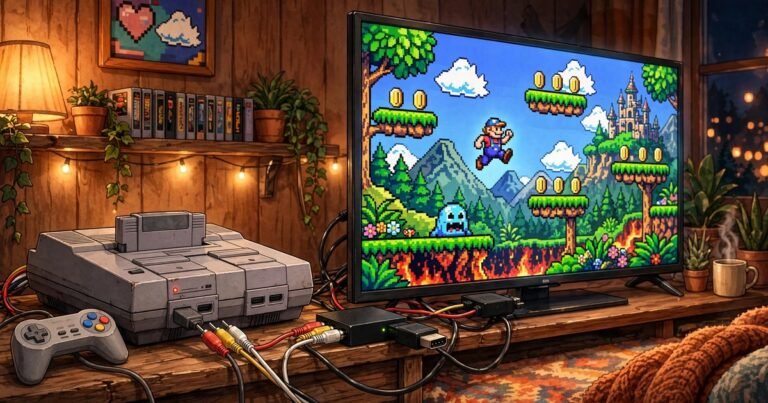
Most legal retro gaming avoids the ROM question entirely. Play original media on original hardware, which is plainly lawful. Connecting that console to a modern television is a solved problem, as our guide to connecting a retro console to a modern TV explains. Buy licensed compilations and mini consoles, which include the licences for the games inside. Use official subscription libraries such as Nintendo Switch Online’s classic libraries, or play homebrew games on an emulator.
Before buying a handheld, check what it actually includes. Our roundup of the best handheld retro games is a starting point, but a licensed library is very different from a grey market device stuffed with unlicensed ROMs. Backward compatibility is another legal route, as in our guide to whether you can play PS2 games on PS3.
Frequently asked questions
Is emulation legal in the UK?
Yes. An independently written emulator is new software, not a copy of a console or game. Problems come from ROMs and BIOS files obtained without permission.
Is it legal to download ROMs if I own the game?
No, not as a general rule. Owning a cartridge does not authorise downloading someone else’s copy. Making your own copy for private use is stronger, and still narrow where copy protection is involved.
What is a BIOS file?
The console’s start-up firmware, usually copyrighted by the console maker. Downloading or sharing a BIOS you do not lawfully hold is a separate infringement.
Is abandonware legal to download?
No. Abandonware is not a legal term. Copyright continues even when a game is no longer sold.
Can I be prosecuted for downloading ROMs?
Infringement can lead to civil claims and, at commercial scale, criminal penalties, but private downloaders are very rarely pursued. Rights holders focus on ROM sites and sellers of preloaded devices.
What is the safest legal way to play old games?
Original media on original hardware, licensed compilations, official subscription libraries, or homebrew games on an emulator.
Conclusion
Emulation in the UK is three questions, not one. The emulator is legal. The BIOS file often is not, unless it came from your own console or a lawful replacement. The ROM is lawful only when you have a genuine right to that copy, and a ROM site download does not give you one, even if you own the game in another form.
About the Author