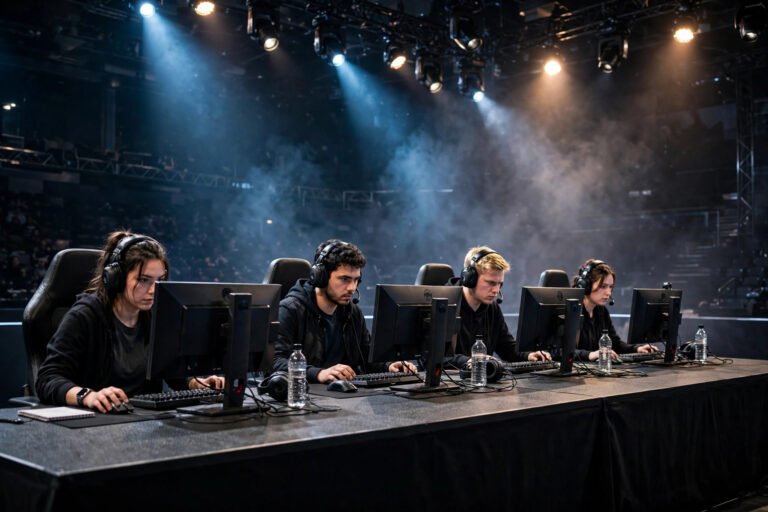

Plenty of young players in the UK dream of wearing a team jersey and competing on stage. The good news is that the path in is more open than ever. The honest news: it is slower and more competitive than most expect.
The short answer: to join an esports team in the UK, you need a high ranked rating in your chosen game, experience playing in amateur leagues or open qualifiers, a presence in the right Discord communities, and the patience to go through trials. There is no single application form. You build proof, get noticed, and earn a trial.
Step 1: Get genuinely good at one game
Every route into a team starts here. Pick one game and commit to it. Teams do not recruit players who split their time across five titles, because reaching a professional standard takes thousands of hours of focused practice.
Aim for the top of the ranked ladder, roughly the top 1%: high Immortal or Radiant in VALORANT, Challenger in League of Legends, or FACEIT level 10 in CS2. Stuck in the middle ranks? The ladder is your training ground for now.
Ranked alone will not get you signed, but without it nobody will take you seriously. Treat your rank as your CV headline: necessary, but not the whole story.
Step 2: Play where UK teams are watching
Once your individual skill is there, you need organised team matches. UK teams recruit from leagues and qualifiers far more than from random ranked games:
| Route | What it involves | Why it helps |
|---|---|---|
| Solo queue grind | Climbing to the very top of ranked play | Proves your individual skill; every team checks this first |
| UK amateur leagues | Season-based leagues such as the UKEL and university competitions | Gives you a public match history and experience playing as a five |
| Open qualifiers | Free-to-enter online cups run by tournament organisers | Anyone can enter, and beating a known team gets you noticed fast |
| Team Discords and LFT posts | Looking-for-team channels on Discord and social media | This is where most amateur rosters in the UK are actually built |
| University and college competitions | Student leagues such as NSE and the British Esports Student Champs | Organised play with a lower barrier to entry, plus an education alongside |
The student route deserves a special mention. If you are 16 to 24, student competitions offer regular matches, coaching, and LAN finals. An esports college course also teaches the wider industry, from coaching to production, keeping your options open.
Step 3: Understand what teams actually look for
Raw skill gets you a look, but teams sign players, not highlight clips:
- Communication. Clear, calm callouts under pressure.
- Consistency. Steady performances across a season of scrims, not one great game.
- Coachability. Taking criticism and learning the team’s system.
- Availability. Most UK amateur teams practise three to five evenings a week.
- Role fit. Teams recruit for a gap in the roster, not for star power.
- Attitude. Managers talk. A reputation for drama follows you in a small scene.
Step 4: Survive the trial
Trials are the standard route onto a roster. A typical UK amateur trial lasts one to two weeks of scrims, sometimes with candidates rotating through the same role. Show up on time, warmed up, with working comms, and play the team’s style rather than trying to carry. Ask about schedules and when you will hear back: a serious team gives you a straight answer.
Contracts: read everything before you sign
Not every amateur team uses contracts, but once money or prizes appear, get it in writing:
- How long it lasts and how either side can end it
- What you are paid, when, and how prize money is split
- Expected hours of practice, content, or streaming
- Who owns your image and social media rights while signed
- What happens if you want to leave for another team
Under 18? Have an adult review anything you sign, and never let anyone rush you. Pressure to sign on the spot is a red flag.
Avoiding scams
The UK scene is mostly honest, but scams target young players desperate for a break:
- Fees to join a team, enter a trial, or “secure your contract”
- Vague organisations with no website, no match history, anonymous staff
- Salary promises far too high for an unknown team
- Contracts you are not allowed to show anyone else
- Pressure to sign immediately or lose the spot
Remember: money flows towards players, never away from them. A real team never charges you to play.
Is there another way in?
Playing is not the only door. Some players win an esports scholarship and get scouted from student leagues; others start as coaches or creators. It is also worth knowing how much pro gamers actually earn in the UK before committing years to the grind.
Frequently Asked Questions
How old do you have to be to join an esports team in the UK?
Most amateur teams take players from 16 up, though games set their own minimum ages. Top professional leagues often require 18, or 16 to 17 with parental consent. Always check your game’s rules.
Do I need to live in London to join a UK team?
No. Almost all UK amateur and semi-pro play is online, so you can trial from anywhere with a stable connection. London hosts more LAN events, but plenty of successful UK players have never lived there.
How long does it take to join a team?
Expect six months to two years of serious practice before you are ready for a competitive roster. Rushing it usually means bouncing between short-lived teams instead of improving.
Can I join a team while still at school or university?
Yes, many do. Student competitions fit around study and evening scrims can work around classes. But be honest if grades slip: very few players earn a living from competing, so protect your education.
About the Author