The question of whether esports counts as a sport is genuinely contested, not settled
Whether video games count as a “real” sport is a genuinely contested question, not a settled one, and reasonable people land on different sides of it for different reasons. Rather than declare a verdict, it’s worth laying out the actual arguments on both sides.
How “Sport” Is Traditionally Defined
Most traditional definitions of sport centre on physical exertion, skill, and competition, often with an emphasis on the body as the primary instrument of performance. This is the crux of the entire debate: esports clearly satisfies the skill and competition elements, but the physical exertion criterion is where opinions genuinely diverge.
The Case That Gaming Is a Sport
Genuine Physical and Cognitive Demands
Competitive gaming at a high level requires reaction times, hand-eye coordination, and sustained cognitive load comparable to many recognised sports, and top players train these skills as deliberately as traditional athletes train physical ones. Studies of professional gamers have found measurable physical strain, including elevated heart rates and stress responses, comparable to some traditional competitive settings.
Structural Similarity to Traditional Sport
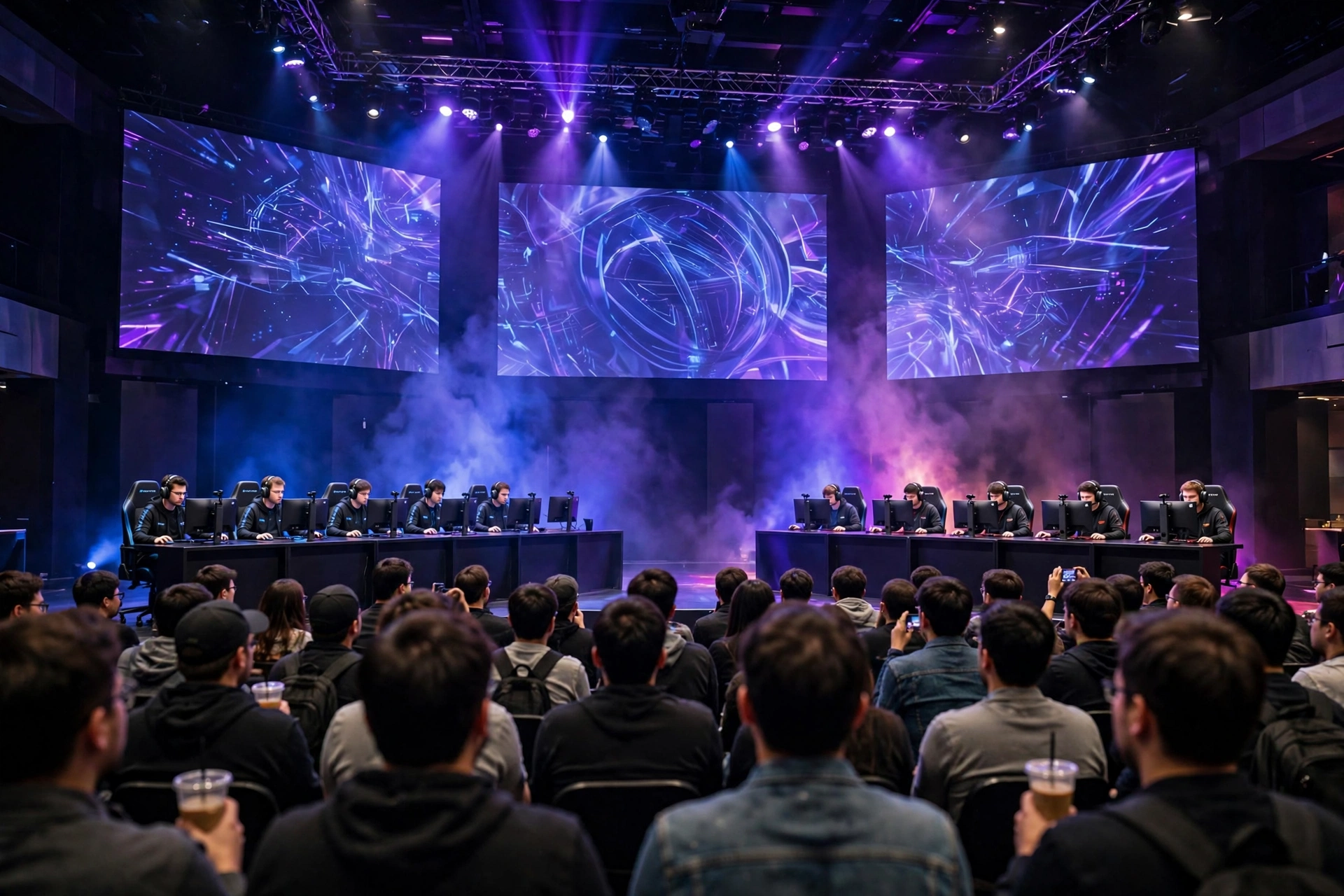
Esports has organised leagues, professional teams, coaches, sponsorships, and international competitions structured almost identically to traditional sports, complete with the National Esports Performance Campus, a GB esports team, and formal training pathways in the UK. The eGames, an international esports competition based on national teams, has even run showcase events alongside the Olympics.
Skill Development and Team Coordination
Team-based esports titles demand the same strategic communication, role specialisation, and coordinated decision-making under pressure that define traditional team sports, arguably at a faster decision-making pace than many physical sports require.
The Case Against Gaming as a Sport
Minimal Physical Exertion
Critics point out that competitive gaming doesn’t require the cardiovascular exertion, physical training regimens, or bodily risk that define traditional sport, and that fine motor skill alone (as with, say, chess or darts, both of which face similar debates) isn’t historically sufficient to qualify as a sport in most people’s understanding of the word.
Different Skill Category Entirely
Some argue esports sits closer to a distinct category, competitive intellectual or reflex-based activity, similar to chess or professional poker, rather than needing to be squeezed into “sport” specifically to be taken seriously as a competitive pursuit.
Commercial Motivation Behind the Label
Skeptics note that framing esports as a “sport” carries genuine commercial incentives (sponsorship access, broadcasting deals, institutional funding) that may shape how enthusiastically the label gets applied, independent of the underlying philosophical question.
Where Official Bodies Currently Stand
This varies significantly by country and organisation. Some national Olympic committees and sports councils have formally recognised esports for funding or classification purposes, while others explicitly exclude it. The UK’s approach, through bodies like the British Esports Association, has focused more on formal education and industry recognition than on lobbying for “sport” classification specifically, which sidesteps the debate in practice even as the semantic argument continues.
Frequently Asked Questions
Do any countries officially recognise esports as a sport?
Recognition varies by country and by specific governing body, with some granting esports formal sport status for classification, visa, or funding purposes while others do not. There’s no single global consensus.
Does chess actually set a useful precedent?
Chess is the clearest real-world comparison, and the details matter here. The IOC recognised FIDE, chess’s global governing body, as an international sporting federation in 1999, which is genuine formal sport status, not an informal courtesy. Chess still isn’t a medal event at the Summer or Winter Olympics, and a push to include it at Paris 2024 didn’t succeed, but the IOC’s own Olympic Esports Series has run chess events, with one 2023 edition drawing 42,000 online participants from 219 countries through a Chess.com-hosted qualifier. If the IOC is willing to grant chess full sport recognition while esports remains a separate “Esports Series” rather than integrated Olympic status, that gap is informative: it suggests physical exertion isn’t the only sticking point, since chess doesn’t clear that bar either, and the IOC has separately said outright that including esports as a medal event is currently premature.
Does it actually matter whether esports is officially called a sport?
Practically, classification affects things like funding eligibility, visa categories for international competitors, and institutional recognition, so the label carries real-world consequences beyond the philosophical argument.
Where Esports Recognition Stands in 2026
The recognition picture has moved a long way in the last few years, but it is still mixed. No single body speaks for all of esports, and different countries have landed in different places. The result is a patchwork, not a clear yes or no.
The biggest stage is the Asian Games. Esports became a full medal event at the 2022 Asian Games in Hangzhou, which were held in 2023. The 2026 Asian Games in Aichi-Nagoya in Japan included 11 esports medal events, covering titles like League of Legends, Mobile Legends: Bang Bang and Tekken. For players from Asia, this is real recognition. Their medals count the same as medals in any other sport.
The Olympics are a different story. The International Olympic Committee announced an Olympic Esports Games in 2024, with a 12 year partnership in Saudi Arabia. That partnership was ended early in October 2025, and the IOC said it would pursue a new approach instead. Reports in May 2026 said the IOC esports commission had been suspended. The Olympic Esports Games has no firm date. The IOC is clearly interested, but it has not committed.
Some countries have moved faster than the IOC. Germany changed its tax law so that esports counts as a recognised non-profit purpose from 2026, which gives eligible clubs tax advantages. South Korea and China have recognised esports players as athletes for years. In the United States, professional players can get P-1A athlete visas, the same type used by Major League Baseball and National Hockey League players. The first was granted to a League of Legends player back in 2013.
The United States also shows the limits of recognition. The NCAA voted in 2019 not to govern college esports. In February 2023, a federal judge in Florida ruled in a preliminary decision that esports does not count as a sport under Title IX, the law that governs sex equality in education. The judge noted that esports does not require athletic ability. That ruling is not final, but it shows how courts still think about the question.
Schools tell a different story. More than 8,000 high schools and 175 colleges in the United States now run varsity esports programmes. The US Department of Education has publicly backed esports as a STEM education tool. In the UK, the British Esports Association has focused on education and industry recognition rather than lobbying for sport classification. The practical result is the same. Young players get structured competition, coaching and scholarships, whether or not anyone calls it a sport.
What Would It Take for Esports to Be Called a Sport Everywhere?
Four problems keep coming up, and until they are solved, full recognition will stay out of reach. The first is governance. Traditional sports have one global federation per sport. Football has FIFA. Chess has FIDE. Esports has no equivalent. Each game has its own publisher, its own league and its own rules. The IOC has pointed to this gap as a key barrier.
The second problem is ownership. A publisher owns the game. It can change the rules, shut down a league, or stop supporting a title entirely. No traditional sport has a single company that owns the sport itself. This makes long term planning hard, and it makes regulators nervous. A sport that one company can switch off is a strange kind of sport.
The third problem is standardisation. Different games have different rules, different formats and different competitive structures. A single definition of esports would have to cover all of them, from a five minute mobile match to a 40 minute strategy game. Traditional sports do not face this problem. Each sport is one thing, with one set of rules.
The fourth problem is integrity. Match fixing, cheating software and performance enhancing drugs all exist in esports, just as they do in traditional sport. But the systems to catch them are younger and less consistent. Anti-cheat tools vary by game. Drug testing is rare. Until esports has the same integrity infrastructure as traditional sport, sceptics will keep using it as a reason to say no.
None of these problems is impossible to solve. They need time, cooperation between publishers, and a governing body with real authority. The Asian Games show what is possible when that cooperation happens. The IOC pause shows what happens when it does not.
Is esports in the Olympics?
Not yet. Esports is not a medal event at the regular Olympic Games. The IOC planned a separate Olympic Esports Games, but the Saudi partnership behind it ended in October 2025, and the plans are on hold while the IOC works out a new approach. Esports was a medal event at the Asian Games, which is the closest it has come to a multi-sport games medal.
Can pro gamers get athlete visas?
Yes, in the United States. Professional esports players can apply for a P-1A athlete visa, the same category used by professional athletes in traditional sports. The first was granted in 2013. The visa does not mean the US government calls esports a sport in every legal sense, but it is formal recognition that pro gamers are professional athletes for immigration purposes.
Final Thoughts
Whether gaming counts as a sport ultimately depends on which definition of “sport” you start from, physical exertion versus competitive skill and structure, and that’s a genuinely unresolved question rather than one with an obvious right answer. Both sides of the argument have legitimate reasoning behind them. If you’re considering esports as a career path regardless of the label, our esports college course guide covers the formal education routes available in the UK.
About the Author