The Sega Game Gear brought colour handheld gaming to the early 1990s
Released in Japan in October 1990 and reaching Western markets the following year, the Sega Game Gear was Sega’s answer to the Game Boy, a genuinely more powerful handheld held back mostly by brutal battery life. Over three decades later, its library remains worth exploring for retro collectors.
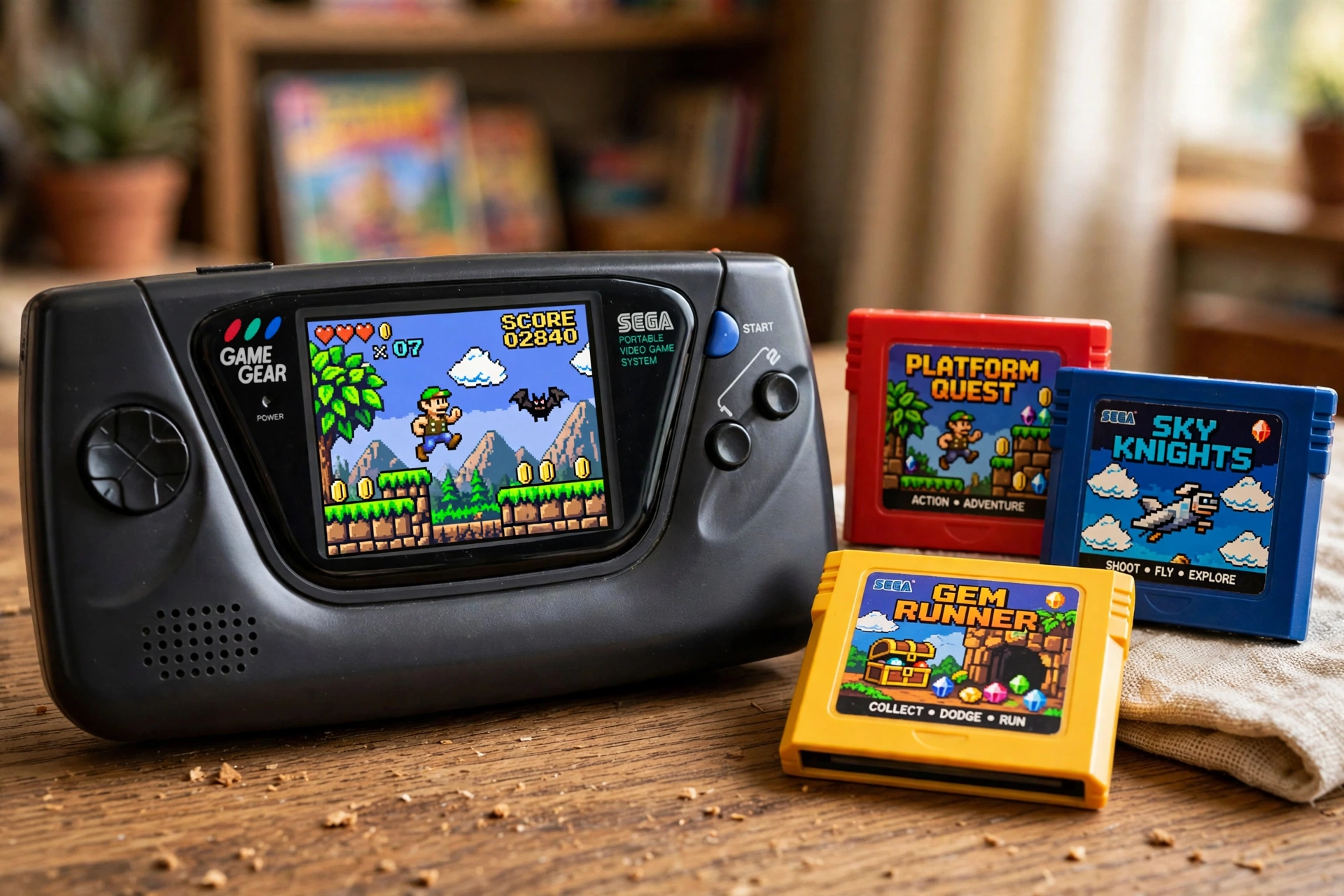
The Hardware, Briefly
Under the hood, the Game Gear was essentially a portable Sega Master System, sharing much of the same architecture, which is why it could receive ported Master System titles alongside its own exclusives. It ran a Zilog Z80 processor at 3.5MHz, with 8KB of RAM and a 3.2-inch backlit colour LCD capable of displaying 32 colours on screen from a palette of 4,096, a genuine step up from the Game Boy’s four-shade green screen. The trade-off was battery life: six AA batteries typically lasted only three to five hours, a significant limitation for a handheld.
Best Sega Game Gear Games
Sonic the Hedgehog Series
Sonic Triple Trouble is widely regarded as one of the best 8-bit Sonic games ever made, portable or otherwise, with tighter level design than several of its Game Gear siblings. Sonic Chaos and Sonic the Hedgehog 2 (a substantially different game from its Genesis namesake) are also worth seeking out for fans of the series’ handheld era.
RPGs
Phantasy Star Gaiden and Sylvan Tales (Royal Blood in some regions) gave the Game Gear a genuinely respectable RPG presence for its era, rare among early-90s handhelds. Shining Force Gaiden also found its way to the system via ports, extending the strategy-RPG series to Sega’s portable.
Puzzle and Arcade
Columns, the Tetris-style puzzle game bundled with early Game Gear units, remains a genuinely solid pick-up-and-play title. Pengo and Bust-A-Move (ported from the Super NES) round out the system’s strong casual/arcade library.
Notable Ports from Other Sega Systems
The Game Gear’s shared architecture with the Master System meant it received an unusually wide range of ports across Sega’s console lineup, including titles originally from the Genesis, Sega CD, Sega 32X, and even Sega Saturn, scaled down for the handheld’s more modest hardware. This gave the Game Gear a surprisingly deep and varied catalogue for a system of its generation, spanning far more genres and source consoles than most 8-bit handhelds ever achieved.
Game Gear vs Game Boy: Quick Comparison
| Sega Game Gear | Nintendo Game Boy | |
|---|---|---|
| Screen | Colour, backlit | Monochrome green, no backlight |
| Battery life | 3 to 5 hours (6x AA) | Around 15 hours (4x AA) |
| Games released | Around 335 | Over 1,000 |
| Best-selling game | Sonic the Hedgehog 2 | Tetris |
Buying and Collecting Tips
Game Gear screens are notorious for developing dead pixel lines and dim backlights with age, so test the screen thoroughly across a range of colours before buying secondhand, since this is by far the most common hardware fault on surviving units. The Master Gear Converter accessory, which allows Master System cartridges to be played on a Game Gear, is a worthwhile find if you want to significantly extend your effective game library beyond native Game Gear titles.
If you’re building out a retro handheld collection, our PS Vita games guide covers a very different, considerably more modern chapter of portable gaming history.
Frequently Asked Questions
How many games were released for the Sega Game Gear?
Around 335 games were released across all regions during the system’s production run from 1990 to 1997.
Is the Sega Game Gear worth collecting today?
For its Sonic titles and surprisingly deep RPG library alone, yes, particularly for collectors interested in early-90s handheld history. Screen condition is the main factor to check before buying, since it’s the most common point of hardware failure.
Can the Game Gear play Sega Master System games?
Yes, with the Master Gear Converter accessory, which adapts Master System cartridges to fit the Game Gear’s cartridge slot, taking advantage of the two systems’ shared underlying hardware.
Hidden Gems: Underrated Game Gear Games Worth Playing in 2026
The best known Game Gear games get all the attention. Sonic, Shinobi and Streets of Rage deserve it. But the handheld hides several games that are just as good and far less talked about. These are the ones worth tracking down first.
GG Aleste is the best shooter on the system. It is a vertical scrolling shoot em up from Compile, the studio behind the Aleste series. The action is fast, the weapon system is generous, and the difficulty is fair. It was only released in Japan, so a cartridge costs more than most Game Gear games. It is still worth it if you love shooters. It shows what the handheld could do when a talented team pushed it.
Tails Adventure is nothing like the Sonic games it spins off from. It is a slow, thoughtful platformer with light RPG elements. You explore, collect items, and use gadgets to open new paths. It rewards patience rather than speed. It is a calm, charming game that suits short sessions. It is also one of the cheapest good games on the system.
Land of Illusion Starring Mickey Mouse is the best platformer on the Game Gear that is not a Sonic game. The levels are varied, the controls are tight, and the presentation is colourful. It is a short game, but every stage feels hand made. It sits beside Castle of Illusion as the high point of Disney on Sega hardware.
Shining Force: The Sword of Hajya is the best RPG on the handheld. It is a tactical strategy game with a real story and a party that grows as you play. Battles are turn based and grid based, and they demand real thought. It connects to Shining Force CD on the Mega CD, which makes it a small piece of Sega history. It is the game to buy if you want depth from the system.
Wonder Boy is a bright, cheerful platformer that plays like a lost classic. It is simple to learn and hard to master. The levels are short and the bosses are memorable. It is a good first game for a new collector because it is fun, affordable, and shows off the colour screen at its best.
How to Play Game Gear Games Today: Hardware, Mods and Emulation
There are three good ways to play Game Gear games in 2026. Each one suits a different kind of player.
Original hardware is the most authentic route. A real Game Gear with a cartridge gives you the exact experience players had in the 1990s. There is one catch. The capacitors inside every original Game Gear fail with age. Most surviving units need a capacitor replacement before they work properly. A recapped unit is reliable and sounds great. Buy from a seller who can prove the work was done. Budget for six AA batteries or a modern rechargeable battery pack, because the original hardware eats batteries fast.
A screen mod transforms the experience. The original screen is dim and blurry by modern standards. A modern IPS screen kit makes the picture bright, sharp and clear. It is the single best upgrade you can make. It costs less than a handful of rare cartridges and it improves every game you play. If you buy a modded unit, check who did the work and whether the shell and buttons are in good condition.
Emulation is the cheapest and easiest route. A handheld emulator, a Raspberry Pi, or a PC can run the whole library. You get save states, screen filters, and a backlit screen. Flash carts like the EverDrive let you play the full library on original hardware from one cartridge. The Analogue Pocket with a Game Gear adapter is a premium option that gives you a superb screen and accurate play. For most players, emulation or a flash cart is the best first step. If you fall in love with the library, add a recapped original unit later.
What is the best Game Gear game for a new collector?
Start with Sonic the Hedgehog 2. It is cheap, common, and genuinely great. Then add Columns for a relaxing puzzle game and Tails Adventure for something different. Those three games cost little and show off the best of the system. Add Shining Force: The Sword of Hajya when you are ready for a longer game.
Do Game Gear games still work on original hardware in 2026?
Yes, the cartridges themselves are hardy and most still work fine. The problem is the console, not the games. Original Game Gear units need new capacitors after thirty years. A recapped unit plays cartridges reliably. Clean the cartridge contacts gently with isopropyl alcohol if a game does not boot on the first try.
Final Thoughts
The Sega Game Gear’s battery life held it back commercially, but its library, particularly its Sonic titles and surprisingly strong RPG catalogue, still holds up for anyone interested in early-90s handheld gaming. Screen condition is the single most important thing to check before buying one secondhand.
About the Author